Utah basements are big, cold and often damp. A coated basement floor is seamless, warm-looking, allergen-free and unbothered by the water heater leak or spring runoff that would wreck carpet or laminate.
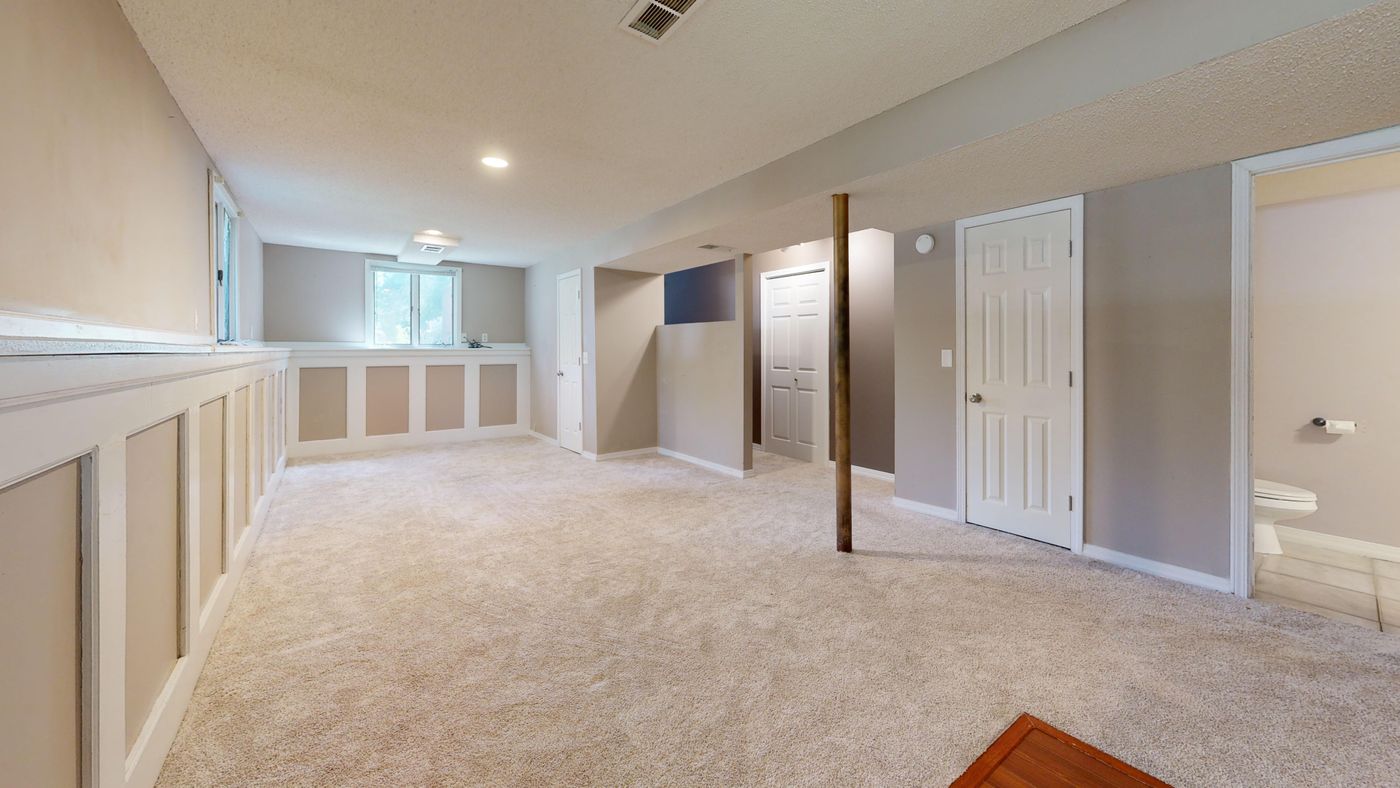
Almost every home along the Wasatch Front has a full basement, and a lot of them are still bare concrete — cold, dusty and gray. Finishing that floor with carpet or vinyl plank means gambling on the slab staying dry, and along the benches and in high-water-table areas near the Jordan River, Utah Lake and the Great Salt Lake, that's a real gamble. Spring runoff, a failed sump, a water heater, a washing machine hose — any of them ends a carpet's life in an afternoon.
A coated basement floor doesn't care. We grind the slab, test it for moisture, apply a moisture-tolerant base coat (with a vapor-barrier primer when the test calls for it), and finish with micro-flake, metallic or solid color under a polyaspartic topcoat. The result reads as finished flooring — warm, seamless, easy to clean — and if water ever does show up, you mop it and move on.
It's also the right floor under a home gym, a workshop, a kids' playroom or a storage room, and it works over radiant heat. For a partially finished basement we can coat the utility and storage side and stop cleanly at the carpet line.
The slab can sweat, the sump can fail, the washer can leak — a coated floor mops dry with no damage.
No carpet fibers, no dust mites, no place for mold to grow. Good for allergies and asthma.
Micro-flake in a warm blend, or a metallic pour, reads as intentional flooring rather than 'unfinished basement.'
On a 1,200 sq ft basement, a coating is often half the cost of carpet-plus-pad-plus-install and lasts far longer.
Rugs, gym mats and furniture sit on it fine; you keep the option to add carpet later.
Polyaspartic systems tolerate in-floor heat that some flooring adhesives don't.
Every SwiftHand floor follows the same sequence. Skipping a step is how coatings fail, so we don't.
Measure the space, check the slab for moisture and old coatings, pick a finish. You get a written price — online in minutes or in person.
We grind the concrete with dust-controlled diamond grinders to open the pores. Never acid etching, which is why our floors don't peel.
Cracks, pits, spalls and control joints are filled with polyurea joint filler and mender, then ground flush. Moisture is tested before anything goes down.
A pigmented polyurea/polyaspartic base coat is rolled on and wets into the ground concrete for a mechanical bond.
Vinyl flake is broadcast to full rejection (or metallic, quartz or solid color applied), then scraped smooth once set.
A clear polyaspartic topcoat locks it all in — chemical, UV and hot-tire resistant. Walk on it that evening; park on it in about 48 hours.
Basement floors are larger and usually need less repair than garages, so per-foot pricing is often lower: roughly $4–$8 per square foot depending on size, finish and whether a vapor-barrier primer is needed. A moisture test at the consultation tells us which — and it's the step that separates a floor that lasts from one that bubbles.
Financing: 0% APR for up to 12 months and $0 down through Wisetack on approved credit — a $3,000 floor is $250 a month, interest-free. Financing details.
Representative photos of the systems on this page. Photos of SwiftHand projects are added as jobs complete.


Usually yes. We test the slab with calcium-chloride and in-situ probe tests. Moderate vapor gets a moisture-tolerant base; high readings get an epoxy vapor-barrier primer first. If the numbers are extreme we'll tell you and talk about drainage before we coat anything.
It's the same temperature as the concrete under it — but it looks far warmer than gray slab, and a rug or gym mat over a sealed, dust-free floor is a lot nicer than a rug over bare concrete.
Micro-flake (1/8-inch) in a warm neutral blend is the most popular because it reads like finished flooring and hides everything. Metallic is stunning in a basement bar or theater. Solid color works for utility and storage areas.
Yes. We routinely coat the unfinished half and terminate cleanly at a doorway or a carpet transition.
Yes. We ask that the system be off during install and for a few days after while the coating cures.
Answer a few questions about the space — size, condition, the finish you like — and our instant quote tool builds a written price on the spot. It takes four to five minutes, not sixty seconds, because an accurate number beats a fast one. Prefer a person? Book a free consultation and we'll measure in person.
Get an instant online price in a few minutes, or book a free in-person consultation. No pressure, no sleazy sales pitch — just a written price.
